
The ROI of AI-Driven Security Systems
How Smarter Detection Reduces Risk, Waste, and False Alarms
Security budgets are often treated like a necessary evil — a cost center that exists purely to prevent worst-case scenarios.
But when security systems are designed intelligently, they do far more than react to incidents. They reduce operational waste, minimize liability exposure, and improve how teams work day to day.
That’s where AI-driven security systems actually earn their ROI.
Not through flashy promises — but through fewer false alarms, faster response, and clearer insight into what really matters.
The Hidden Cost of “Normal” Security Noise
Most businesses don’t realize how much their current security system is costing them — not in hardware, but in time, attention, and risk.
Traditional systems generate a constant stream of alerts caused by:
Weather changes
Lighting shifts
Shadows
Animals
Passing vehicles
Every alert demands attention. And most of them lead nowhere.
Over time, that noise creates:
Wasted staff hours reviewing footage
Slower response to real incidents
Frustration and alert fatigue
Teams mentally tuning out notifications altogether
When everything is urgent, nothing is.
Why Traditional Motion Detection Fails at Scale
Legacy security systems rely on simple motion detection. Any movement inside a camera’s field of view triggers an alert — no context, no prioritization.
That works in theory. In practice, it floods teams with meaningless data.
The more locations you have, the longer your operating hours, or the larger your facility, the worse the problem becomes. Reviewing footage turns into a daily chore instead of a targeted response.
This is where AI changes the game — not by replacing systems, but by making them smarter.
How AI-Driven Security Actually Works
AI-driven security systems add intelligent video analytics on top of existing cameras and infrastructure.
Instead of detecting “movement,” AI analyzes what’s happening in the scene.
It can identify:
A person entering a restricted area
A vehicle approaching after hours
Loitering near entrances
Abnormal movement patterns
The result isn’t more alerts — it’s better alerts.
Alerts that matter.
Alerts that get acted on.
Alerts that lead to faster outcomes.
A Real-World Example: AI Security in Action
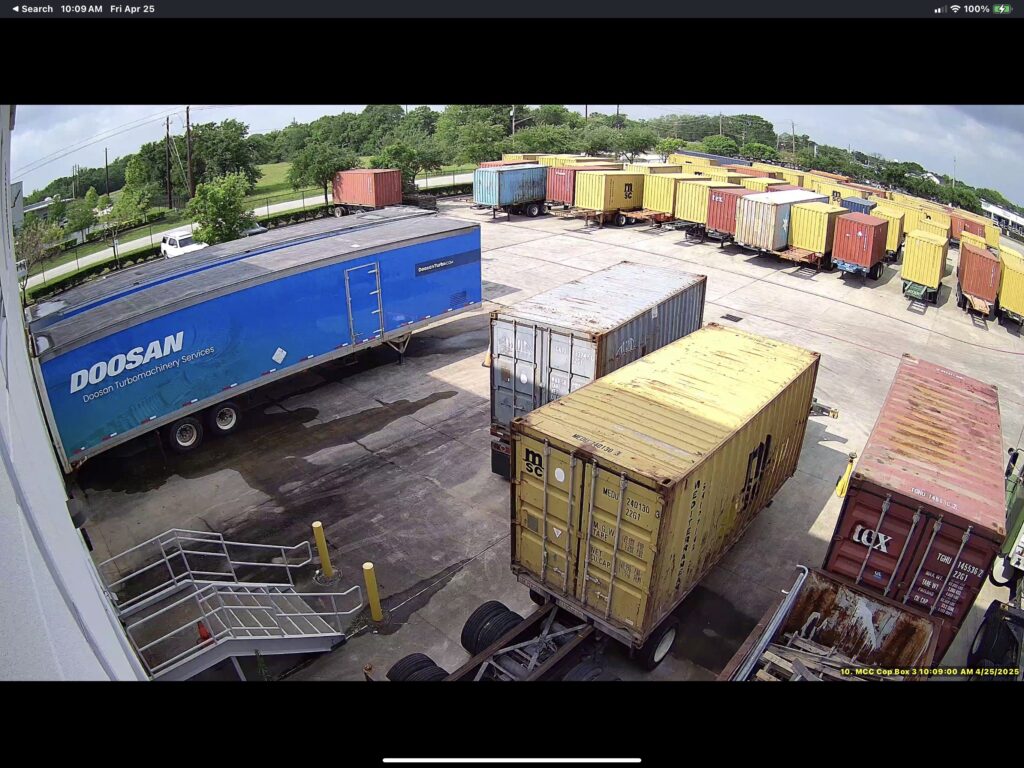
Recently, MCC upgraded security for a national logistics operation with large, high-value truck yards and constant after-hours activity.
The challenge wasn’t a lack of cameras — it was visibility.
Learn more about how MCC helped solve their logistics security nightmare.
Less Noise = Less Operational Waste
When alert volume drops, everything else improves.
Fewer false alarms mean:
Faster investigation times
Less time reviewing footage
More focused security teams
Better accountability and documentation
AI doesn’t just reduce noise — it gives teams back mental bandwidth.
That’s where real operational efficiency shows up.
Risk Reduction Is Financial Protection
Every delayed response increases exposure:
Property damage
Theft or loss
Liability claims
Compliance violations
AI-driven systems shorten response windows by surfacing real threats immediately. That reduction in response time directly impacts outcomes — and costs.
Security stops being reactive and becomes preventive.
Scaling Security Without Scaling Headcount
One of the biggest ROI advantages of AI-driven security is scale.
With intelligent analytics, businesses can:
Expand camera coverage
Monitor multiple locations
Improve visibility after hours
Avoid hiring additional security staff
Technology becomes a force multiplier, not a staffing burden.
What AI Security Does Not Do
Let’s cut through the hype.
AI-driven security does not:
Replace human oversight
Fix poor camera placement automatically
Compensate for bad lighting or physical barriers
Eliminate the need for thoughtful system design
AI enhances a well-designed system. It doesn’t magically fix a broken one.
That’s why strategy matters just as much as technology.
Where AI-Driven Security Delivers the Most Value
AI analytics tend to provide the strongest ROI in environments where accuracy matters more than volume, including:
Warehouses and distribution centers
Multi-location businesses
Retail environments
Healthcare facilities
Large office buildings
In these settings, fewer false alarms and faster response directly translate to lower risk and smoother operations.
Is AI Security Right for Every Business?
AI-driven security isn’t a one-size-fits-all solution — and it shouldn’t be treated like one. The real value depends on several factors, including the size of your facility, how often it’s occupied, and the infrastructure you already have in place. Businesses with extended operating hours, multiple access points, or large outdoor areas tend to see the strongest return, especially when false alarms are already a problem. Risk exposure also plays a role; environments that handle high-value assets or sensitive operations benefit more from faster, more accurate alerts. That’s why a proper assessment matters. It’s the only way to determine whether intelligent analytics will meaningfully improve security — or simply add another layer without real payoff.
Turn Security Noise Into Operational Clarity
If your current security system generates more alerts than insight, you’re not getting ROI — you’re absorbing risk.
AI-driven security isn’t about chasing trends. It’s about making security work for your business, not against it.
Let’s evaluate whether intelligent analytics make sense for your environment — and where they’ll actually deliver value.
Request a Security Assessment Today!Looking for something specific?
Want the latest news in your inbox?
 | Thank you for Signing Up |
 | Thank you for Signing Up |

