
Laser vs Lamp Projectors:
The Business Buyer’s Comparison (2026)
Laser vs Lamp Projectors: Which One Is Right for You?
MAINTENANCE
Lamp-based projection systems require more maintenance than their laser counterparts because lamps need regular replacement when they burn out—a process that takes time away from you being able to focus on other things during your presentation or event at hand. With a laser projector system, though, there’s no need for messy cleaning procedures or costly maintenance contracts as with lamp-based ones since there aren’t any fragile components in between the image source and screen (essentially meaning it does not require cooling).
You’ll need to do some maintenance tasks for your lamp-based projector. These include:
- Replacing the lamp every 1-3 years can cost up to $300.
- Cleaning the lens at least twice a year (you should use a microfiber cloth), and a service provider typically does this. The cost of this is approximately $150 per cleaning cycle.
- Maintaining condenser lenses and filters which may also require professional cleaning or replacement if they become damaged or worn out over time.
Understanding Total Cost of Ownership
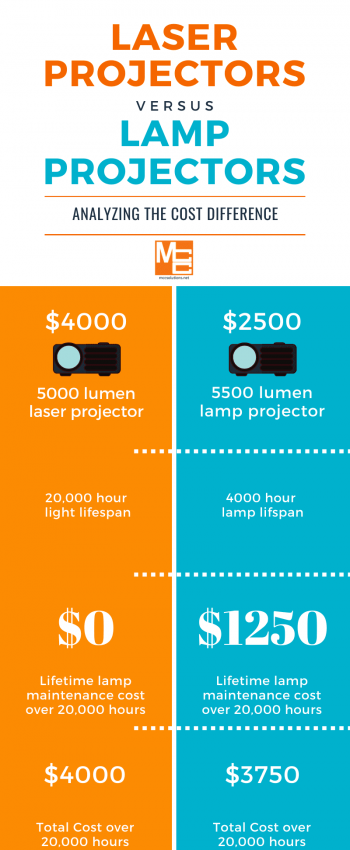
Although the initial cost might be higher for the laser projector, when you factor in the lamp replacements, labor/service calls, downtime impact, and energy use, the total cost is about equal. Then factor in the significantly better quality of image from the laser projector, and the winner is clear.

LIFESPAN
Here are some of the reasons why laser projectors last longer than lamp projectors:
- Laser projectors aren’t as susceptible to dust or dirt. Their optical components don’t get dusty, so they don’t need cleaning as often. Since they aren’t often exposed to dust and dirt, laser projector optics won’t wear out as fast as lamps. For example, if you’re a business owner who uses a projector for presentations in your meeting rooms every day for 8 hours per day, you might have to change your lamp every month or so—but with a laser projector, that could be years down the road!
- They’re more reliable and efficient overall. Because lasers give off less heat than fluorescent bulbs (which means there’s less stress on the other parts), they last longer without needing repairs or maintenance work done. They also use less power than traditional lamps because no filament inside can burn out very easily (making them super energy efficient). And since lasers don’t use any glass lenses like what would be found inside an incandescent bulb fixture—they don’t break easily either!
- They require fewer replacements over time due to their superior quality construction materials used during manufacturing processes, such as “copper cladding” techniques, which provide better conductivity between materials.
COST
The final benefit of laser projection is the cost. Laser is more expensive than lamp, and it will stay that way for a while. However, the cost savings over the long run make the laser projector the cheaper option because laser projectors require less maintenance, last longer, and do not require bulb replacements.
Lamp projectors need frequent bulb replacement due to their fragile nature; lasers don’t have this issue because they’re built with solid-state technology that doesn’t burn out like a traditional LED or incandescent bulb would. They also last longer than most lamps before they need servicing—upwards of 15 years compared with just five years for an average lamp projector! And while they may cost more upfront, lasers have even been proven by experts such as Energy Star to be more energy efficient than typical lamp projectors by about 20%.
If you’re in the market for a projector, consider a laser-based model because it could help your company save money and keep things running smoothly.
| Feature | Laser Projectors | Lamp Projectors |
|---|---|---|
|
Lifespan |
20,000+ hours |
2,000-5,000 hours |
|
Maintenance |
Minimal |
Regular lamp replacement |
|
Brightness consistency |
Stable over time |
Degrades as lamp ages |
|
Upfront cost |
Higher |
Lower |
|
Long-tern cost |
Lower |
Higher |
- If you’re in the market for a new projector, one of these systems may be worth considering. You’ll initially pay more for them than other models, but they last longer and do not require expensive lamp replacements.
- A laser-based model also requires less maintenance and is more energy efficient than its traditional lamp counterparts; this means that your office will have to spend less time worrying about repairs or replacing bulbs at inconvenient times.
- These projectors are also faster to set up—there’s no need to fiddle with a bulky lens system or wait for the light source to warm up before use can begin!
In conclusion, there are many benefits to using laser projection systems over traditional models. They’re faster, more cost-effective and last longer than their counterpart. However, these advantages can only be enjoyed if you’re willing to make the switch now!
Projector FAQs
In most professional and high‑use environments, yes. While laser projectors cost more initially, they typically last 20,000+ hours without lamp replacements, significantly reducing long‑term maintenance, downtime, and service costs. For organizations that rely on projectors daily, the total cost of ownership is often lower with laser systems.
Laser projectors commonly operate for 20,000 to 30,000 hours before brightness degrades, while lamp projectors usually require lamp replacement every 2,000 to 5,000 hours. This difference makes laser projection better suited for continuous or mission‑critical use.
Yes. Lamp projectors can be a practical choice for environments with occasional use, limited budgets, or minimal runtime requirements. For small conference rooms or infrequently used spaces, lamp‑based systems may provide adequate performance at a lower upfront cost.
Laser projectors are typically better for conference rooms because they offer faster startup times, consistent brightness, quieter operation, and minimal maintenance. These benefits reduce meeting delays and IT intervention, especially in shared or high‑traffic meeting spaces.
Lamp projectors require regular lamp replacement, filter cleaning, and periodic servicing. Laser projectors use sealed optical engines with no consumable lamps, resulting in far less maintenance and fewer interruptions over the life of the system.
Lamp projectors are still available, but many manufacturers are prioritizing laser technology due to its reliability, efficiency, and lower long‑term costs. As laser projection becomes more affordable, it is increasingly becoming the standard choice for business, education, and healthcare environments.
2 Responses